
 Back to blog
When you place a trade, where does it actually go? The answer depends on whether your broker runs an A-Book or a B-Book model, and that single distinction shapes everything from the prices you get to whether your broker profits when you lose. Understanding it is one of the most useful things a serious trader can learn.
“An A-Book broker earns from spreads and commissions, not from your losses. Its interests are aligned with yours.
Why the way your broker handles your orders may matter more than the spread it advertises.
A-Book vs B-Book: the core difference
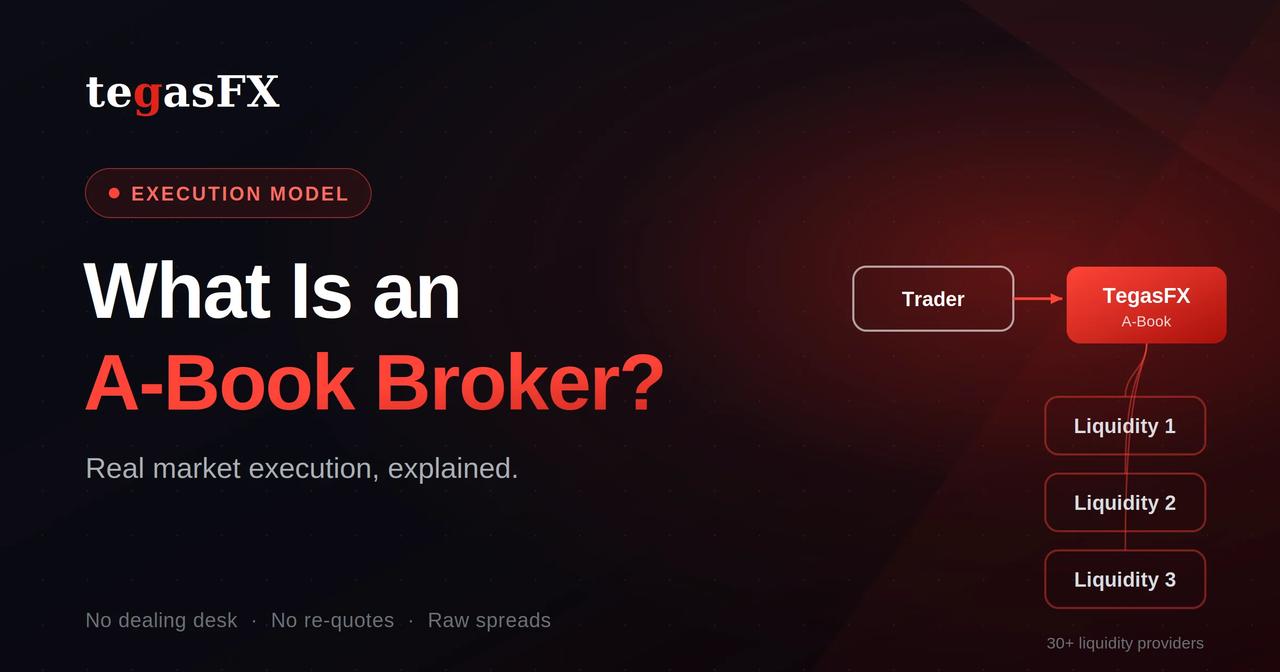
An A-Book broker passes your orders through to the real market, to a pool of external liquidity providers such as banks and institutions. The broker does not take the other side of your trade. It earns from spreads and commissions, not from your losses, so its interests are aligned with yours: it wants you to trade more and stay active.
A B-Book broker, the classic market maker, keeps your orders in-house and takes the opposite side of your trade. When you lose, the broker tends to gain. This creates a structural conflict of interest, and it is why some market makers have a reputation for re-quotes, slippage at inconvenient moments, or widened spreads during volatility.
Where orders go
A-Book: to external liquidity providers. B-Book: kept in-house.
The broker's position
A-Book: neutral intermediary. B-Book: takes the opposite side.
How the broker earns
A-Book: spreads and commissions. B-Book: often from client losses.
Conflict of interest
A-Book: none. B-Book: structural.
Typical execution
A-Book: no dealing desk, no re-quotes. B-Book: dealing desk intervention possible.
How ECN/STP execution works
A-Book describes the business model. ECN and STP describe the technology that delivers it. Both route your orders directly to liquidity providers with no dealing desk in between.
ECN
Connects you to a network where banks, institutions, and other participants compete to fill your order, often producing tighter spreads and visible market depth.
STP
Passes your order straight through to liquidity providers without manual intervention, so there are no re-quotes and no artificial delays.
tegasFX execution in practice
At tegasFX, accounts combine both ECN and STP. We connect you to a deep liquidity pool of over 30 top-tier liquidity providers, which means orders are executed without dealing desk intervention: no re-quotes, no hidden markups, and pure raw spreads.
Why it matters for your trading
Pricing integrity
With no incentive to trade against you, an A-Book broker has no reason to manipulate spreads or execution.
Cleaner fills
Direct market access tends to deliver fewer surprises during fast-moving or volatile sessions.
Transparency
Raw spreads plus a clear commission structure are easier to audit than a spread-only model that may hide a markup.
Alignment
Your broker does better when you keep trading, not when you lose your balance.
High-volume trading and costs
Execution quality matters most for high-volume traders. If you are a scalper, EA user, or high-frequency trader, execution quality and costs compound quickly, which is why tegasFX also offers volume rebates for frequent and large-volume traders.
How to tell if a broker is really A-Book
Plenty of brokers describe themselves as ECN or STP. Because those terms are not always strictly policed, it pays to look past the label and check the signals that are harder to fake.
A clear commission model
True ECN/STP brokers typically charge a transparent commission on top of raw spreads. A zero-commission, all-in spread pitch can hide a markup.
Named or counted liquidity sources
A genuine A-Book broker connects to a pool of external liquidity providers and is usually willing to say so. tegasFX connects to a pool of over 30 top-tier liquidity providers.
Execution policy in writing
Look for a stated no-dealing-desk, no-re-quote execution policy. Vagueness here is a flag.
Behaviour during volatility
Market makers are most tempted to widen spreads or delay fills around news. Direct-market-access models pass through whatever the underlying market is doing.
tegasFX trading account conditions
tegasFX runs a true A-Book ECN/STP environment on MetaTrader 5. The core characteristics are below.
Execution model
A-Book ECN/STP, no dealing desk intervention.
Pricing
Raw spreads with a transparent commission structure.
Liquidity
Pool of 30+ top-tier liquidity providers.
Order handling
No re-quotes, no hidden markups.
High-volume traders
Volume rebates available for scalpers, EA users, and HFT.
Platform
MetaTrader 5.
Three common misconceptions
A-Book brokers are always cheaper
Not necessarily. An A-Book broker often charges a separate commission, so the headline spread can look higher. The real comparison is total cost per trade, spread plus commission, against the quality of execution. For active traders, tighter raw spreads and clean fills usually win even with a commission.
ECN and STP are the same thing
They overlap but are not identical. ECN connects you to a network where participants compete to fill your order and you can often see market depth. STP routes your order straight through without a dealing desk. Many brokers, including tegasFX, combine both.
Execution model does not affect me as a small trader
It affects every trader. A conflict of interest does not disappear because your account is small. With A-Book, the broker has no reason to want your trades to fail, from your first lot to your largest position.
Frequently asked questions
What is an A-Book broker?
An A-Book broker passes client orders through to external liquidity providers rather than taking the opposite side. It earns from spreads and commissions instead of client losses, which removes the conflict of interest found in market-maker (B-Book) models.
What is the difference between A-Book and B-Book?
An A-Book broker routes your trades to the real market and stays neutral. A B-Book broker (market maker) keeps trades in-house and takes the opposite side, so it may profit when you lose. A-Book aligns the broker's interests with yours.
Is tegasFX an A-Book or B-Book broker?
tegasFX operates a true A-Book ECN/STP model, connecting traders to a pool of over 30 top-tier liquidity providers with no dealing desk intervention, no re-quotes, and raw spreads.
What does ECN/STP mean?
ECN (Electronic Communication Network) connects you to a network of competing liquidity providers. STP (Straight Through Processing) routes orders directly to those providers without manual intervention. Together they deliver direct market access.
What spreads does tegasFX offer?
tegasFX ECN/STP accounts use raw spreads with a transparent commission structure. Exact spreads vary by instrument and market conditions, and current live spreads are shown on the tegasFX trading accounts page.
Does an A-Book broker charge commission?
Typically yes. Because an A-Book broker does not profit from a marked-up spread, it usually charges a clear commission on top of raw spreads. This is generally more transparent than an all-in spread that may hide a markup.
Is A-Book better for scalping and EAs?
Direct-market-access execution suits high-volume strategies such as scalping, EA-based, and high-frequency trading, because clean fills and low costs matter more as volume rises. tegasFX also offers volume rebates for these traders.